47 christening ideas shaped around the child, not protocol
Published on August 21, 2026 · The Fotelya team
A christening is often planned like a smaller wedding: a sit-down meal, speeches, a day that stretches into the evening. Except the guest of honor is only a few months old and will set the schedule, whatever the invitation may say. Here are forty-seven ideas, organized by what they solve: the pace, the venue, the entertainment, and everything that will only be opened much later.
The pace: the child sets the schedule
The decision that changes everything is not the menu, but the timing. A christening that ends early leaves joyful memories; the same event stretched out until eight in the evening leaves children exhausted and parents who have spoken to no one.
- A brunch from eleven o’clock, with no table service. People get up, mingle, and talk. A sit-down meal keeps everyone beside the same person for three hours.
- Afternoon tea instead of a full lunch, if the ceremony is in the late morning. Shorter, less expensive, and no one falls asleep.
- A schedule built around the child’s nap, not the venue’s availability.
- A separate space planned for naps, with a mattress on the floor and the curtains drawn in a quiet room. It allows the celebration to continue without waking anyone.
- The speech and group photo before dessert, while everyone is still at the table and reasonably attentive.
- A backup picnic plan in case of rain, decided in advance rather than improvised that morning.
- A finishing time stated on the invitation. No one will dare to leave first if the time is not written down.
Arrange the venue so the day flows naturally
A successful christening depends greatly on six practical arrangements, all decided before the first guest arrives.
- A space for pushchairs near the entrance. Without one, they end up blocking the way and everyone has to step around them.
- A quiet room equipped for babies to sleep : this is what determines whether young parents stay or leave at three o’clock.
- A low table reserved for the youngest children, at their height, with everything they need on it.
- Round tables for six, not long banquet tables. Six people can talk together; fourteen can only talk to the two beside them.
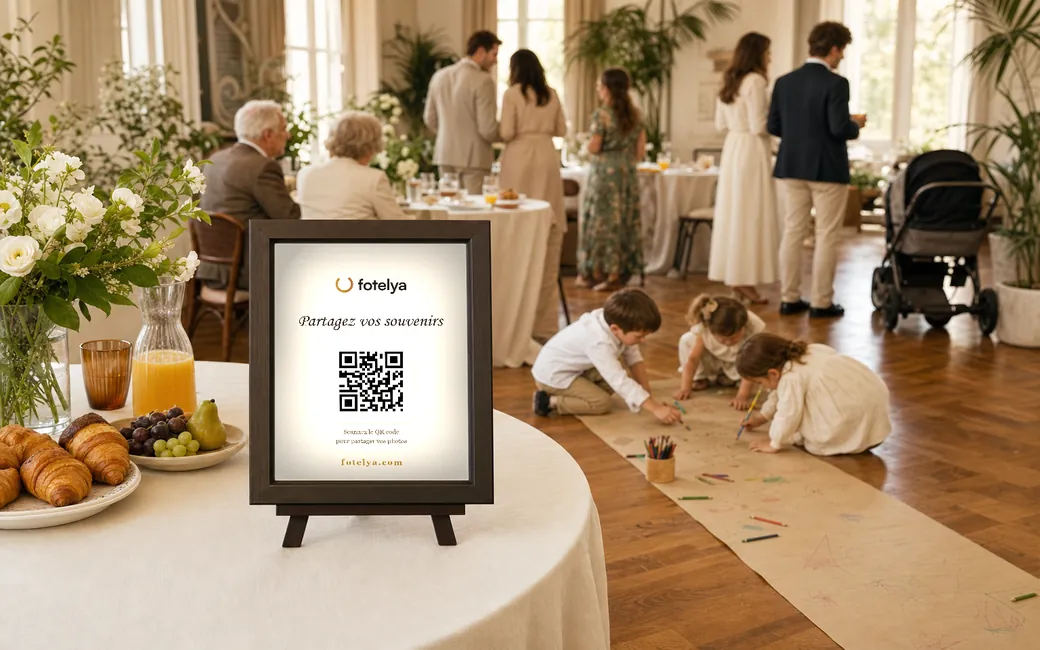
- Three meters of kraft paper rolled out on the floor with crayons. The children entertain themselves for two hours, and a work of art remains at the end.
- Sugared almonds replaced with a homemade jar : jam, biscuits, or seeds to plant. Sugared almonds end up forgotten at the bottom of a bag.
Entertain the children, and the adults too
The lull at a christening always comes at the same point: between coffee and departure. Six ideas fill it without an entertainer or a budget.
- Riddles about family first names : who had that name, in which generation, and where it comes from.
- Guessing the child’s future height and profession, with each person writing their prediction on a dated piece of paper. Open the predictions again in twenty years.
- A collaborative drawing on a large canvas, for the parents to hang in the child’s bedroom.
- A treasure hunt to keep the older children entertained, written for eight to twelve-year-olds, the ones who are always overlooked.
- Photos of the parents as babies, side by side. Everyone tries to decide whom the child resembles, providing an entire thread of conversation.
- A garland of baby photos of every adult present, for guests to identify. Simple, free, and remarkably effective.
What will only be opened in ten or twenty years
That is what makes a christening unique: the guest of honor will remember none of it. Everything written that day is intended for someone who does not yet exist. Eight ideas embrace that time gap.
- A sealed box, to be opened when the child comes of age. Place everyone’s contributions inside, seal it, and write the date on it.
- A book of wishes to read at eighteen, with each guest writing one page.
- A letter from the parents, sealed until the child comes of age, written the night before, while everything still feels new.
- A letter from the godfather to read at ten, a closer and more tangible date for a child.
- A wish written by every child present, together with their age that day. These are often the most perceptive.
- Everyone writes a question for the child to read as an adult, rather than offering advice. A question ages better than a recommendation.
- A piece of advice, written, dated, and signed, without reading anyone else’s. The repetition of the same advice is a message in itself.
- A wishing tree where messages are hung throughout the day, then gathered that evening.
Voices, not just images
Christenings are photographed extensively and almost never recorded. Yet it is the grandparents’ voices people will regret not having, not one more photo of the cake.
- A recording of the godfather’s and godmother’s voices, just a few words, recorded that very day.
- Each guest records one minute addressed to the adult the child will become.
- A recording of the text read during the ceremony, often chosen with care and never preserved.
- Each grandparent recounts the day the child was born, in their own words, without preparation.
- The same song sung by the whole family, recorded exactly as it is, wrong notes included.
- Film the child describing the day themselves, years later, while looking through the photos.
The photos no one thinks to take
After a christening, people end up with forty photos of the buffet and none of the child with their grandmother. Six photos need to be planned in advance, or they will never exist.
- A portrait of the child with every guest, one by one. It takes time, and it is exactly what everyone will look at in thirty years.
- A portrait with each side of the family, the father’s side, the mother’s side, then both together.
- A photo of every hand resting on the child, without any faces. It ages remarkably well.
- The godparents’ hands around the child’s, in close-up.
- A photo of the empty venue before anyone arrives. No one thinks of it, yet it is the only image that shows all the preparation.
- One person responsible for the official photos, chosen in advance. Otherwise, everyone assumes someone else is taking care of them.
Objects that endure through time
Five objects that cost almost nothing and, twenty years later, become the only things no one would part with for anything in the world.
- A framed footprint with the date, made that very day.
- The same outfit worn across three generations, if there is one, together with a photo of everyone who wore it.
- The christening gown photographed laid flat, as an object in its own right, before or after the day.
- A tree planted that very day, photographed every year on the same date.
- An heirloom passed on, entrusted to someone who will return it many years later.
A chosen mentor, in addition to the official godparents
An idea that is becoming increasingly popular and deserves its own section: alongside the ceremony’s godparents, choose someone for the role they will genuinely play.
- Someone chosen for the role they truly play, without any religious framework or family obligation.
- A sentence read aloud that day, clearly expressing what is expected of them. Without it, the role remains vague and gradually fades away.
- An annual meeting, arranged from the very first day : one date every year, just for them and the child.
This idea resolves a common source of discomfort: official godparents are sometimes chosen for family reasons, while the person who will truly matter has no title. Here, both can coexist without taking anything away from anyone.
Where to start when planning the baptism
Forty-seven ideas are too many for a single day. Three are enough, chosen from three different categories.
One decision about timing (the brunch, or a schedule built around nap time), one adjustment to the venue (the quiet room, or the kraft paper), and one lasting keepsake (the sealed box, or individual portraits). Once those three are in place, the rest will follow naturally.
And just one scheduling rule: the parents’ letter should be written the night before, not three months later. What you feel that day cannot be recreated.
Gather everyone’s photos on the day itself
Several ideas on this page rely on the photos, voices and words reaching one shared place. This is where things most often go wrong, for one simple reason: the photos stay on people’s phones. Everyone intends to send theirs, no one does, and six months later the parents have received five.
A shared album solves the problem while everyone is still there.
- Create the album using the child’s name and the date. You will receive a link and a QR code.
- Print the poster, already beautifully laid out, and place it on the tables and near the buffet.
- Guests scan it with their phone camera. No app, no account, no password for a grandmother to remember.
- They add photos, videos and written messages, all in one place.
- You receive everything in full quality, without messaging app compression.
The free album is enough for a typical baptism: around four hundred photos, the written guestbook and photo challenges. Voice messages, which bring the recorded voices idea directly to life, are available with a one-time paid plan, with no subscription.
One detail matters especially when a child is involved: the photos are hosted in the European Union, the album is visible only to people who have the link, an optional access code can be added, and everything is automatically deleted after the event. Nothing is shared on social media.