Wedding Thank-Yous: Thoughtful Words and Photos to Treasure
Published on October 19, 2026 · The Fotelya Team
A wedding thank-you means more when it recalls a thoughtful gesture, someone’s presence or a particular memory. Whether on a card, in a message or by email, a few personal words accompanied by the guest photo album let you give everyone a little piece of the day.
The short answer
To write a wedding thank-you, thank the recipient for being there, helping out or doing something thoughtful, then mention a personal memory. Aim to send it within four to eight weeks of the celebration: this is a practical guide, not an obligation. Include the shared album link so everyone can enjoy the photos. On a printed card, a QR code can sit alongside a short, readable web address.
Find the right tone before choosing your wording
The best starting point is not an elegant turn of phrase, but what you genuinely want to thank someone for. A reassuring presence during the preparations, a journey to attend the ceremony, a speech or a thoughtful gesture from afar immediately gives you something personal to draw on. You can use the same basic structure for several recipients, provided you change the detail that makes each relationship unique.
Distinguish between someone’s presence and their gift, too. Thanking them only for money or an item can make the day seem to be about what you received. Instead, start with the joy of sharing your wedding, then mention their thoughtful gesture if you wish. For someone who could not attend, thank them for their message or gesture without suggesting they were there.
You can copy and adapt the templates below. Replace the details in square brackets, remove any sentence that does not sound like you and check that your recipients can open the album link. A simple note signed with both your first names will feel more natural than a formal declaration in a style that is not your own.
Close family and friends: say thank you with a memory
For close family, on a card
“Thank you for being there and for all the love that surrounded our wedding. We treasure the memory of [shared moment], and we know how much you did to support us. We are delighted to share these photos of the day with you: you can open the album using the QR code on this card or at this address, [album link]. With love, [first names].”
For parents, a brother, a sister or grandparents, explain what their support meant to you. A single sentence can be enough: “Knowing you were close by before the ceremony meant so much to us.” If several people receive the same card, a few handwritten words help keep that personal touch.
For friends, in a message
“Thank you for bringing so much joy to our wedding. Your [speech, dance move, fit of laughter] is one of the memories we will treasure for years! We wanted to give a little of that wonderful energy back to you with the photos from the day: [album link]. With love, [first names].”
A group message works well for friends, but avoid mentioning a memory that only involves some of the recipients. You can send a shared message with access to the photos, followed by individual notes to anyone you would like to thank more personally. The link is a gift for them to enjoy whenever they wish, with no reply expected.
Guests who could not attend, wedding witnesses and vendors: words for each recipient
For someone who could not attend, by email
“Thank you for your message and for thinking of us on our wedding day. We were truly touched to know we were in your thoughts. We wanted to share a few memories of the day with you: you can find the photos here, [album link]. With love, [first names].”
This wording assumes neither a gift nor an explanation for their absence. If they sent flowers or a card, simply mention that gesture. Avoid anything that might sound like a reproach, such as “It is a shame you did not make the trip.” The album lets them discover the celebration without having to explain why they were not there.
For your wedding witnesses, on a personal card
“Thank you for being our wedding witnesses, and so much more. We look back on [specific gesture] with such fondness: having you there truly meant a great deal to us. We are also sharing the memories gathered in our album, [album link], so you can revisit the big moments and all the little details. With all our love, [first names].”
If your wedding witnesses played different roles, write to each of them separately. Thanking someone for specific help makes a message more meaningful than a general line about a perfect day. You can also mention a quiet moment away from the speeches and entertainment: sometimes those discreet gestures deserve the most recognition.
For a vendor, in a professional email
“Hello [first name], we wanted to thank you for your support with our wedding. We particularly appreciated [specific aspect of the service]. Your work helped create [memory or observed result], and we wanted to tell you personally. Thank you again, [first names].”
You do not need to include the album link in every professional thank-you. If you would like to show a few images of the work delivered, choose a suitable selection: “Here are a few photos we wanted to share with you: [selected photos link].” Sharing these images does not grant permission to publish them; any public use should be discussed separately.
Card, message or email: adapt the format without losing the warmth
A wedding thank-you card to keep
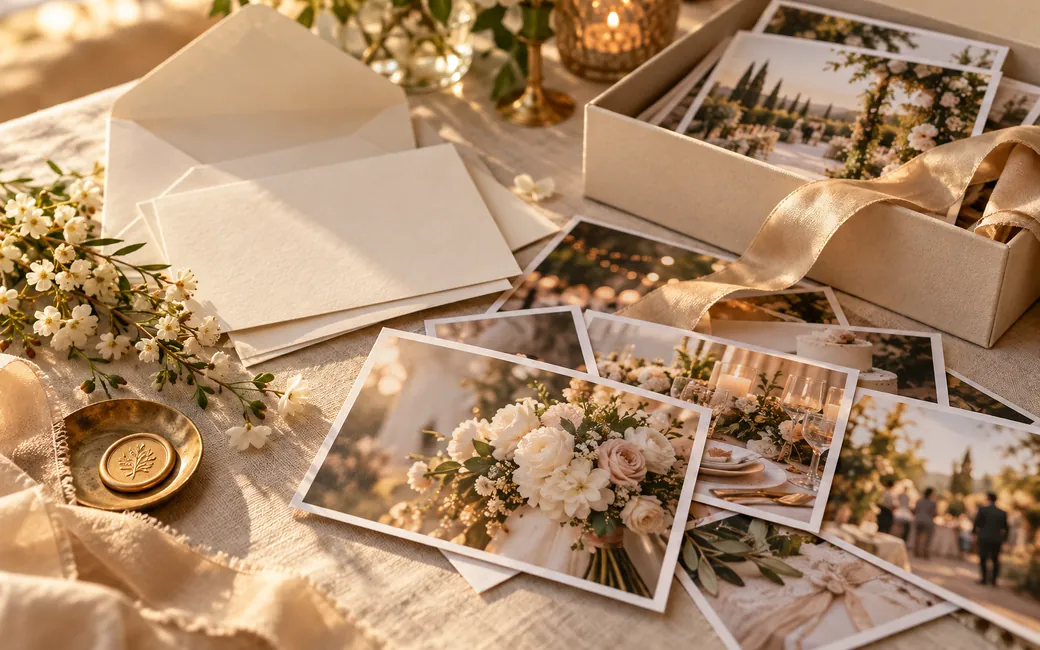
A printed card is a tangible keepsake and a lovely setting for a carefully chosen photo. Leave enough space for the text to remain readable, then place the album details on the back or below your signature. A clear caption, such as “Our wedding photos”, explains what the QR code opens.
Short version to copy: “Thank you for surrounding our wedding with so much love. Your presence and thoughtful gestures meant a great deal to us. Revisit the memories of the day in our album: [album link or QR code]. With all our love, [first names].” A clearly printed web address gives those who prefer not to scan another way to access it.
A message that still feels personal
For a text or messaging app, a few sentences are enough. Send the link in the same message as your thank-you so its purpose is clear. If your recipient finds online albums difficult to use, simply offer to look through the photos together or send them a small selection.
Straightforward version: “Thank you for being at our wedding and for [personal gesture]. We loved sharing the day with you. Here are the photos so you can revisit those memories: [album link]. With love, [first names].”
An email that is easy to find again
A subject line such as “Thank you for sharing our wedding, plus photos to enjoy” makes the contents clear. In the email itself, separate your thank-you note from the link to make it easier to read. For a group email, use BCC so you do not share everyone’s email address with the other guests.
When should you send wedding thank-yous?
Sending your thank-yous within four to eight weeks of the wedding is a reasonable planning guideline, not a legal requirement or a universal rule of etiquette. This gives you time to go through the messages you received and prepare your cards. It should not, however, become a reason to delay a thank-you that is already ready to send.
You do not need to wait for every photograph before writing. If the guest album already contains memories you would like to share, you can send your thank-you with that link. The photographer’s images can be shared separately, depending on when they are available and the terms agreed with the photographer.
If you are sending your thank-yous later than planned, avoid a lengthy explanation. “We took our time choosing these memories, but our gratitude has never faded: thank you for sharing our wedding.” Then add a personal touch. Your recipient should receive a thank-you, not feel obliged to reassure you about your timing.
To avoid leaving anyone out, start with your guest list and the thoughtful gestures you received, including those from people who could not attend. Simply note your chosen format and whether you have sent the thank-you. This discreet record helps you nurture relationships, not compare the value of gifts or make every message the same.
Share everyone’s photos without turning your thank-you into a request
An album link changes the feel of a message when it is presented as something you are giving. “Revisit your memories of the celebration” is more welcoming than “Send us the missing photos”. Everyone can discover a moment that happened elsewhere, a group photo or a detail they had not noticed.
If you opened a Fotelya album for your wedding day, that same space can accompany your thank-yous. There is no need to create a new album to give the photos you gathered a second life. Before sending the link, take a moment to review the content and remove anything you do not wish to share.
For anyone who has not yet uploaded their photos, one optional sentence is enough: “If you still have a few photos you would like to add, you can upload them to the same album: [album link].” Place it after your thank-you, without insisting or asking for an explanation.
A separate follow-up makes the most sense when you are waiting for a particular photo someone has told you about. The thank-you itself should feel complete even if no more photos arrive. That lack of expectation is what gives it warmth: you are expressing gratitude for what you shared and offering memories to revisit.