136 wedding ideas, organized by what they actually solve
Published August 21, 2026 · The Fotelya Team
Most lists of wedding ideas are lists of decorations. Yet a year later, what people remember is rarely the flowers: it is feeling too hot, sitting next to someone interesting, being able to get home without driving, or not having spoken to their grandmother. Here are 136 ideas, organized not by decorative theme, but by the problem they solve.
Guest comfort, what they truly notice
A guest does not judge a wedding by the tablecloth. Without ever saying so, they judge it by thirteen practical details that determine whether they had a wonderful day or simply endured it.
- Water on every table, without anyone having to ask. The simplest detail, and the one most often forgotten.
- A misting fan and shade during the drinks reception, whenever the weather is hot.
- A basket of ballet flats organized by size, brought out at the start of the evening.
- Warm slippers brought out after dessert, if the evening continues outdoors.
- A bench set apart for a quiet breather, visible but away from the center.
- A supervised cloakroom, announced at the entrance. Without an announcement, no one feels comfortable leaving their coat there.
- Twenty matching umbrellas arranged by the entrance : they cost little and save a rainy arrival.
- A lit fire pit for those who stay, late into the night.
And five ideas centered on a room that almost no one plans for, even though it is often the most frequently used space of the evening.
- A small, softly lit room open all night, away from the dance floor.
- No music, and a door that actually closes. A “quiet” room with bass coming through the wall serves no purpose.
- Grandparents and children naturally take turns using it , without any need to organize it.
- A discreet sign at the entrance, so no one has to ask where it is.
- A proper nap break included in the schedule, for days that begin early.
The children, and the evening it frees up
A wedding with twenty children can make it through dinner without a single outburst. This is not a matter of luck, but of eight decisions, all made before the big day.
- A children's room with mattresses and a night-light, prepared before they arrive.
- Two paid childcare professionals. It is the budget item that gives parents their evening back.
- Serve the children one hour before the adults : they eat when they are hungry, and the adults' dinner becomes an entirely different experience.
- A table at their height, served twenty minutes earlier.
- A screening room, with pajamas requested on the invitation. Parents know what to bring, and the children fall asleep there.
- Give each child a role during the ceremony : carrying, handing things out, reading a sentence.
- Let the children speak first, one sentence each, before the adults' speeches.
- Have the children tell the story of the proposal as they saw it : their version is always better than the couple's.
Grandparents, the regret that comes up after almost every wedding
When asked a year later, couples almost always name the same regret, and it is neither the budget nor the weather. Six decisions can prevent it.
- Name the regret for what it is : too few meaningful moments with their grandparents, because the day passes quickly and they think there will be time.
- Ten minutes of posed photos with them, somewhere quiet, included in the schedule like everything else.
- Record their voices as they tell the story of their own wedding. That is what will one day be gone.
- Seat them beside the dance floor, not tucked away at the back. They can see everything without having to move around.
- Let the grandparents open the dance floor, before the newlyweds.
- A photograph of the hands of four generations, without their faces.
The journey home, what guests remember most
The end of the evening shapes the overall impression. Seven decisions, all logistical, and all best announced in advance rather than on the night itself.
- A return shuttle every hour, rather than a single departure at three in the morning.
- Announce the shuttle with the invitation : that is what determines who drives.
- Display the timetable from the drinks reception onward, rather than making guests search for it at midnight.
- A designated driver assigned to each table, informed in advance.
- List accommodation options on the invitation, along with the distances.
- One well-lit, clearly signposted departure point.
- A relaxed late breakfast the next morning : those who stay meet again, and it is often the best part.
The seating plan, and how to break the ice
No one imagines that the seating plan could shape the entire evening. Yet it determines whether two hundred people talk to one another or remain with those they already know.
- Assign seats according to when each guest met the couple: the table tells its own story.
- Do away with the singles' table and truly mix everyone together.
- Mix both families at every table, rather than placing one on each side of the room.
- Name each table after a year in the couple's story, with a note about what happened then.
- Name the tables after the places you have traveled to together.
- Replace table numbers with dates that matter.
- On the back of each place card, explain why that person is there. Two lines written by the couple, and no one throws them away.
- A sign at the entrance showing who everyone is, on the groom's side and the bride's side.
- A display featuring each person's photograph and first name.
- A photograph of each guest placed at their seat, as their place card.
And five ideas to help people who do not know one another at the start of the meal begin talking before dessert.
- A quiz that requires both families to work together to answer.
- One question per table, with the answer read aloud over the microphone during the meal.
- A booklet of gentle challenges, one for each guest, with nothing embarrassing.
- Guess which childhood photos show the newlyweds from a display at the entrance.
- A map of France, with each guest adding a pin, one for every place they come from.
Giving everyone a voice: speeches, microphones, and those who cannot be there
Long-winded speeches are the moment guests dread and no one dares to shorten. Five ideas keep the conversation flowing instead of letting one person take over.
- An hourglass placed in front of the speaker. No one takes offense, and everyone respects it.
- One timed minute, with an hourglass in full view, announced to each speaker in advance.
- A microphone passed around during dessert, three questions asked of anyone who wants to answer.
- The witnesses’ words slipped into the menu, to be read rather than endured standing up.
- The witnesses filmed just before their speech, while they are still nervous.
The second most common regret among newlyweds is not having spoken to anyone. Four decisions can fix that.
- Go from table to table during the starter, not during dessert, when everyone has moved around.
- Two minutes per table, timed by a witness who comes to get you.
- Delegate the logistics and switch off your phone for the entire day.
- Thirty minutes with no photos, no speeches, nothing at all, set aside somewhere in the schedule.
And four ideas for those who could not attend, and whose absence is deeply felt.
- A scheduled video call, at an agreed time, not improvised.
- A message from those who could not attend, read during dessert.
- A voice message from a loved one unable to return from abroad, played for the room.
- Interviews filmed without the newlyweds knowing, edited and screened that evening.
The moment the room falls silent
At almost every wedding, there is a moment, never included in the schedule, when two hundred people fall silent at once. Six ideas to make it happen.
- The parents’ wedding photo, projected while the room is dining.
- A letter read by the person who introduced them.
- The song that was playing the night they met, played without an announcement.
- The mother’s dress worn for a single photo, taken during the day.
- The parents’ wedding photos at the same age, side by side.
- A letter from the parents, read to camera before the wedding day, then shown that evening.
What you open again in one year, or in ten
Ten ideas that cost almost nothing on the day itself and become far more meaningful over time.
- Letters from guests to open in ten years, one from each person.
- One card per person, with a single question, the same for everyone.
- Everything is sealed that same evening, with the opening date written on it.
- A case of wine placed in the cellar for their tenth anniversary.
- A bottle from the wedding year slipped into the box.
- Postcards the newlyweds will send in one year, written by the guests.
- A sealed box containing two letters, for the difficult days, written by the newlyweds to each other.
- The newlyweds write their own, without reading it to anyone.
- A photo taken at the same time every year thereafter, beginning with the one taken on the wedding day.
- Sign a tablecloth that will be embroidered afterwards : the guestbook that belongs on a table.
The photos a photographer never thinks to take
A professional captures the ceremony and the couple beautifully. Nine images almost always escape their lens, simply because no one requested them.
- Behind the scenes and in the kitchen, while the room waits.
- The group photo taken from an upstairs window, with everyone looking up.
- The venue photographed empty, before and after. No one thinks of it, yet it is the only image of all the work that went into the day.
- Every pair of shoes photographed before the dancing, lined up in a row.
- Recreate the first-date photo in the same place, in wedding attire.
- A proper studio portrait of each family, carefully posed in a dedicated corner.
- A portrait of every couple attending, taken somewhere quiet. It is often the only photo of the two of them that year.
- A photo of the newlyweds on the hour, every hour, from morning until night.
- Each guest leaves with someone else’s photo, printed on-site and exchanged.
Book the photographer for less time, and entrust the rest to others
Four hours with a photographer instead of twelve: the decision feels daunting, yet almost always proves worthwhile, provided what follows is carefully organised. Seven ideas.
- The professional captures what cannot be recreated : preparations, ceremony, portraits, group photos.
- The evening is entrusted to the guests and their phones, which are already out anyway.
- A simple instruction displayed on the tables, so the photos all end up in one place.
- Sort through them together the next day, keeping thirty photos. That is how many people truly look at.
- One disposable camera per table, to be finished before midnight. The constraint is part of the charm.
- An old phone placed somewhere for guests to leave a voice message.
- A guestbook with one question per page, rather than a blank page where everyone writes the same thing.
And four ideas around a divisive decision: seeing each other the day before rather than in the aisle.
- A private moment together the day before, without a photographer.
- The attire remains a surprise, but without a hundred eyes watching at the moment of discovery.
- The tears fall in private, and the ceremony feels different.
- The schedule regains the hour otherwise spent hiding from each other all morning.
The music, if you let the guests choose
Letting guests create the playlist takes courage and calls for six ground rules.
- Each person adds one song when confirming their attendance, in the RSVP form.
- Each guest chooses the song that reminds them of the newlyweds, not their favourite song.
- One sentence alongside it: why this song matters. It can be read aloud when the song plays.
- The newlyweds retain the right to veto ten songs, without having to explain why.
- The DJ receives the list one week beforehand, not on the evening itself.
- The list of forbidden songs is displayed, putting an end to requests.
The meal, served out of order
Serving dessert before the main course sounds absurd and remains a story people tell for years. Five ideas for the table.
- Dessert immediately after the starter, with everyone seated, while everyone is still attentive.
- The main course served later, on large sharing platters, once the evening is underway.
- Two desserts, one favourite for each newlywed, presented as such.
- Cutting the cake before the first dance, while the room is still full.
- A dish inspired by a grandmother's recipe, with her name on the menu.
Lowering the bill without anyone noticing
Eight choices that genuinely reduce the budget, without any guest noticing.
- Wine bought directly from the estate, with the corkage fee negotiated with the caterer.
- Alcohol bought directly from the estate, with service arranged separately.
- Seasonal flowers sourced from a grower rather than a florist.
- Bouquets bought at the market that same morning.
- Mismatched tableware sourced from flea markets, then resold afterwards.
- All the stationery printed in a single run : invitations, menus, place cards and signs.
- A caterer booked outside peak-season Saturdays.
- Menus printed at home, with an anecdote on the back.
Two structural decisions: Thursday, and the guest list
These are the only two decisions that change the budget by an order of magnitude, rather than by a few percentage points.
- Getting married on a Thursday: the budget per guest moves up a tier, because you invite fewer people and can host them better.
- Suppliers are available and more open to negotiation during the week.
- Guests travelling from farther away can turn it into a long weekend, which changes how they feel about the journey.
- The venue is available the day before, so you can set everything up without rushing.
- Some guests cannot take time off work, so you need to tell them very early, at least six months in advance.
- One rule announced very early, with no exceptions, to narrow the guest list without causing resentment. Exceptions create conflict, never the rule itself.
- An intimate ceremony, followed by the celebration one month later, with everyone there.
- Colleagues invited only to the cocktail reception, clearly stated on the invitation.
Decorate with things that feel like you, and throw nothing away
Seven ideas for decor that does not look as though it came from a catalogue, and does not end up in a skip on Sunday morning.
- A single colour, ranging from white to its darkest shade. The simplest way to make everything feel intentionally chosen.
- Flowers from a loved one's garden, with nothing purchased.
- A cutting taken from the family garden, then replanted at your home afterwards.
- Potted plants taken home by guests as they leave.
- Cut flowers reserved for the bridal bouquet alone, with long-lasting greenery everywhere else.
- The venue contacted to reuse the previous day's decor, when it is hosting two weddings in succession.
- An arrangement with a nearby care home, which collects the floral arrangements the following day.
What keeps the day from going off course
Four decisions, all made around one month in advance, that make the difference between a seamless day and one spent putting out fires.
- A single point of contact for suppliers on the day, whose number appears on every contract. Not the couple.
- A wet-weather backup plan decided one month in advance, including the deadline for switching plans and who makes the decision.
- The schedule displayed at the entrance, hour by hour. Guests stop asking the question.
- Dietary requirements and allergies requested on the reply card, not in front of the buffet.
Where to begin if the list feels overwhelming
Naturally, one hundred and thirty-six ideas will not all apply to a single wedding. Four are enough, chosen from four different categories.
One decision about comfort (water on the tables, or the quiet room), one decision about getting home (the shuttle announced with the invitation), one decision about connection (mixing the two families, or spending ten minutes with the grandparents), and one lasting keepsake (the sealed box, or a portrait of every couple).
If you remember only one: the ten-minute photo session with the grandparents, written into the schedule. Its absence appears in nearly every list of regrets, and it is the one thing you can never recreate.
Collecting photos from two hundred guests, without spending six months on it
Many of the ideas on this page depend on photos, messages and voices arriving somewhere. That is precisely where things break down, for one simple reason: two hundred people take photos, but nobody sends them. Six months later, the couple has received around thirty images, compressed by a group chat where nobody replies anymore.
A shared album reverses the burden: guests upload their photos on the spot, while the celebration is happening.
- Create the album with your names and the date. You receive a link and a QR code.
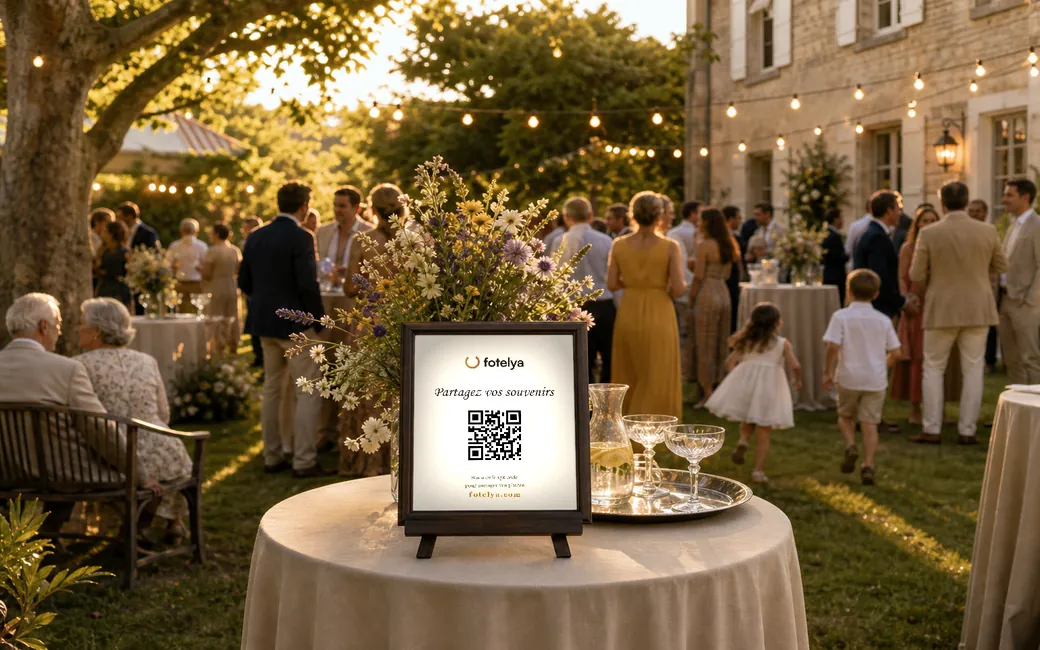
- Print the sign, already professionally laid out, and place it on the tables and at the cocktail reception.
- Guests scan it with their phone camera. There is no app to install and no account to create, which matters when your guests range from seven to ninety years old.
- They upload photos, videos and written messages to the same place throughout the evening.
- You receive everything in full quality, without messaging-app compression, including moments you did not witness.
The free album covers a typical wedding: around four hundred photos, the written guestbook and photo challenges. Voice messages, which directly support several ideas on this page, are included in a paid plan with a one-time payment, no subscription and no commitment.
Photos are hosted in the European Union, the album is visible only to people with the link, an optional access code is available, and everything is deleted automatically after the event. Nothing is shared on social media.