Wedding entertainment: which ones really work
Published on July 26, 2026 · The Fotelya team
Most wedding entertainment lists feature thirty ideas without saying which ones work, what they cost, or what remains the next day. This guide does the opposite: it examines each activity based on what it actually produces during an evening, depending on when it takes place.
What we really expect from an activity
A good wedding activity isn't meant to keep guests busy: they know how to entertain themselves. It serves three purposes, and it's worth knowing which one you're aiming for before choosing.
Helping people who don't know each other to meet
A wedding brings together two families, childhood friends and colleagues who have never exchanged a word. The activities that work best at the start of the day are those that give people a reason to talk to each other, not those that require them to get on stage.
Creating a moment everyone watches together
An evening needs two or three turning points where attention gathers: the arrival of the bride and groom, the speech, the first dance. An activity can create one more, provided it doesn't add to an already busy moment.
Leaving something behind after the party
This is the most overlooked criterion, yet the only one that still matters six months later. An activity that leaves nothing has taken up twenty minutes. An activity that leaves behind images, messages or an object continues to exist.
Activities that work, by time of day
Welcome drinks: keep things moving
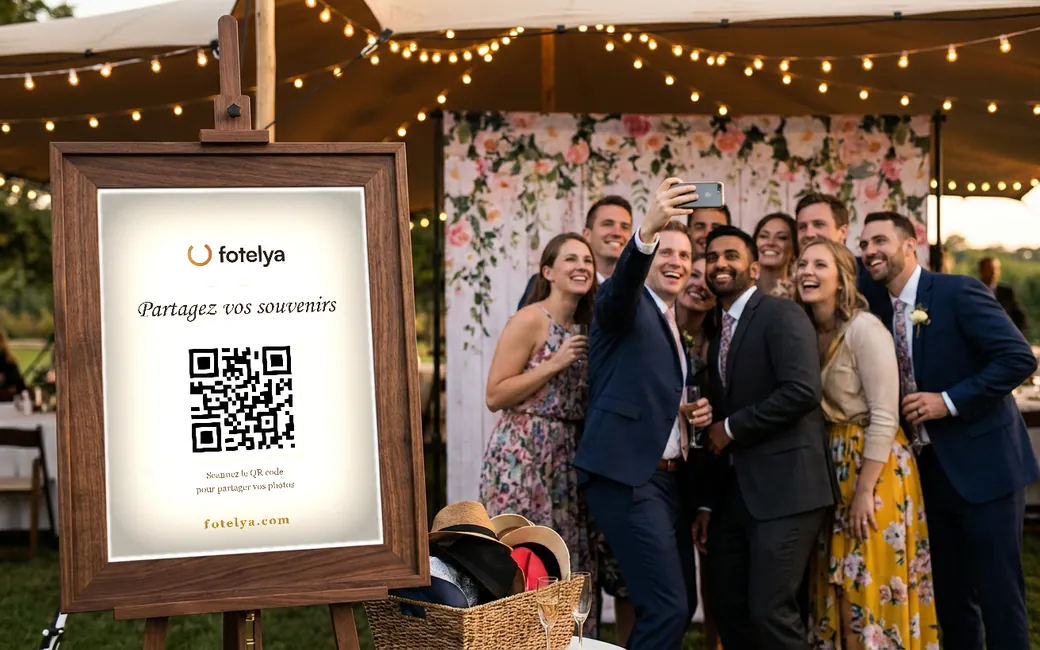
This is the most favorable moment of the entire day. Guests are standing, available, curious, and they have their phones in hand. Anything that involves moving around or talking works: a photo corner with a few props, a guest recognition game, a bar for something that requires queuing and therefore conversation, a photo collection via QR code that starts as soon as guests arrive.
What doesn't work at this time: anything that requires sitting down and listening. People have just arrived, they're looking for familiar faces.
Dinner: filling the gaps between courses
Service creates fifteen to twenty-minute lulls that guests spend waiting. This is where table activities come into their own: a quiz about the couple slipped into the menu, a question per table for everyone to answer, a guestbook that circulates, a photo wall that displays in real time what the room has just captured.
What doesn't work: stringing together speeches, slideshows and games all at once. Three consecutive highlights cancel out the effect of all three.
Dance party: don't impose anything
Once the dance floor is open, the best activity is the one that asks for nothing. Guests who are dancing don't want to be interrupted, and those who aren't dancing are looking for a quiet place. A photo corner that runs autonomously, a screen broadcasting images from the evening, a place to take a break: all of this works because no one needs to participate.
Honest comparison: impact, budget, effort, what remains
The four columns below are the ones missing from most idea lists. The amounts are rough estimates for France, to be adjusted according to your region and season.
| Activity | Impact during the evening | Indicative budget | What remains |
|---|---|---|---|
| Photo booth with prints | Strong, focused around the booth | Several hundred euros | Printed photos, and files if the provider supplies them |
| Photo collection via QR code | Spread out, throughout the day | Low | All the guests' photos and videos |
| Live photo wall projected in real time | Strong, and it boosts participation | Weak if the venue has a screen | The same images, already gathered in one place |
| Live band | Very strong throughout the evening | High | The memories, and what the guests have filmed |
| Board games and quizzes | Moderate, depends heavily on the host | Very low | Little to nothing, unless the answers are saved |
| Guestbook, written or voice-recorded | Weak during the party | Very low | Plenty, and it’s revisited years later |
| Fireworks or sparklers | Very strong, lasts two minutes | Variable, often regulated | A few photos, if someone remembered to film |
| Professional photographer | Naturally discreet | High | A polished report, delivered weeks later |
The useful takeaway from this chart isn’t to pick the highest-rated column, but to see that the columns don’t overlap. An animation with strong immediate impact often leaves little lasting trace, and vice versa. A balanced wedding draws from both categories.
The animations that most often disappoint
Let’s be honest, since no one includes them in idea lists.
- The ones that require guests to perform in front of everyone. A minority loves them, most dread them, and the atmosphere drops for those who didn’t want to participate.
- The ones that last more than ten minutes. Beyond that, attention drifts and conversations resume, giving the impression of a wasted moment even if it was just too long.
- The ones that rely on a single host. If the person is in top form, everything runs smoothly. Otherwise, there’s no backup plan.
- The ones that require setup the day before. On the big day, the venue is rarely available as early as promised, and it’s always the animation that gets cut.
- The ones that ask guests to install an app. Every step before participating loses people, and it’s rarely the ones you’d expect.
How much to allocate
There’s no strict rule, but a useful benchmark: animations typically account for between five and ten percent of the total wedding budget, once the venue, catering and outfits are paid for.
The budget trap
Putting the entire budget into one spectacular performance leaves the rest of the day with nothing. Conversely, ten small animations scattered throughout don’t create any standout moments. Two or three well-placed animations, including one that’s free or nearly free, can cover an entire evening.
What costs almost nothing and works
Collecting photos from guests, the guestbook, tabletop games and a makeshift photo corner with a few accessories fit within a minimal budget. These are also, for three of them, the only activities that leave something to consult after the party.
The forgotten common thread: the photos
All your activities will be photographed by the guests. That’s what connects them, yet almost no one plans how to retrieve these images.
The photographer covers the day with their perspective, but they can’t be at the cousins’ table while photographing the speech. Guests, however, are everywhere, all the time, and take hundreds of pictures that remain on their phones.
A single collection point, displayed as early as the welcome drinks, turns this dispersal into one shared album. It doesn’t replace any activity: it preserves what all the others have produced. And if the venue has a screen, projecting these photos throughout the evening becomes an activity in itself, without asking anything of anyone.
Planning the flow, in practice
- Choose one activity per moment : one during the welcome drinks, one at dinner, one in the evening. Three is enough.
- Make sure none of them overlaps with a highlight already planned, like a speech or the cutting of the cake.
- Assign each activity to a named person, a witness or a close friend. An activity without a responsible person only happens half the time.
- Ensure that at least one of them leaves a trace that can be consulted later: photos, messages, recordings.
- Test everything that depends on a screen, a network or a connection the day before, not on the day itself.
- Accept that an activity might not take off. It happens, and it’s not a problem if the other two work well.